Don't Swim Around It — How Training Through Resistance Makes You Unstoppable
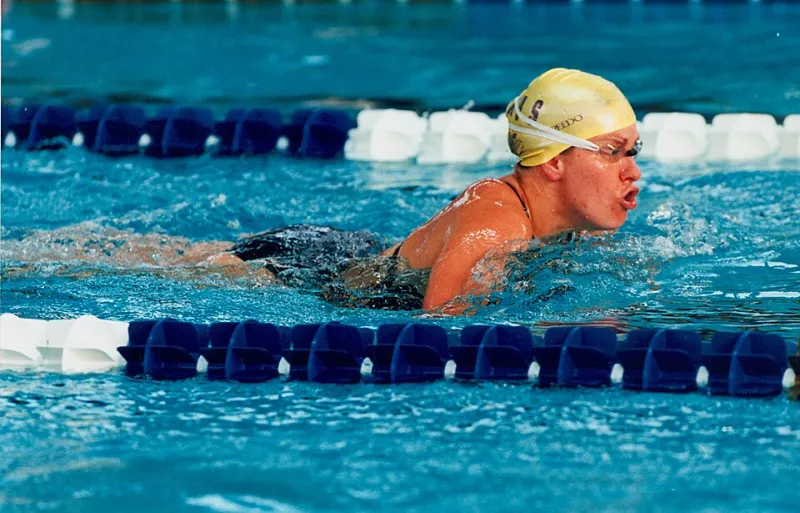
Photo: John Sherwell, CC BY-SA 3.0, via Wikimedia Commons
Anybody who's spent time in the ocean knows the feeling. You're swimming parallel to shore, minding your business, and suddenly the water has other plans. A rip current grabs you, pulls hard, and every instinct in your body screams the same thing: fight it, swim straight back to the beach, burn every ounce of energy you have against it.
Spoiler: that's exactly the wrong move.
Experienced ocean swimmers know the drill — you don't battle a rip current head-on. You angle out of it, work with the water's energy, and use the resistance itself to navigate toward safety. It's counterintuitive, but it works. And it turns out, that same logic applies to almost everything that makes beach training hard.
The Obstacle Is the Workout
Here's a mindset shift worth making: the conditions that feel like they're working against you are often the most valuable part of your session.
Chopping through knee-high surf on a beach run isn't just inconvenient — it's resistance training your gym treadmill could never replicate. Unstable, waterlogged sand that swallows your foot with every stride forces your stabilizer muscles to fire in ways flat, predictable surfaces simply don't demand. Headwinds off the Atlantic or Pacific that slow your sprint aren't obstacles to your workout — they are your workout.
The beach doesn't offer a controlled environment. That's the whole point.
Most athletes — whether they're training in Malibu, Miami Beach, or the Jersey Shore — have been conditioned to seek ideal conditions. Perfect weather, calm water, a flat surface. But that conditioning creates a fragile athlete. One who performs beautifully in a controlled setting and falls apart the moment things get real.
What Resistance Actually Does to Your Body
Let's get specific about the physical side of this, because the science is genuinely compelling.
When you train in unstable, high-resistance environments — think soft sand, shallow surf, or fighting a current during open-water work — your neuromuscular system has to work overtime. Your body can't rely on stored movement patterns. It has to constantly recalibrate, recruiting more muscle fibers, activating your core more deeply, and improving what exercise scientists call proprioception — your body's ability to sense its own position in space.
That translates directly to injury resilience. Athletes who regularly train on unpredictable surfaces develop stronger ankles, more reactive hips, and a more stable base overall. The same goes for cardiovascular adaptation. Training against resistance — whether that's water drag during a swim or a brutal coastal crosswind — forces your heart and lungs to work at a higher output for the same perceived effort. Over time, that builds a bigger aerobic engine.
You don't get that by waiting for calm conditions.
The Mental Game Is the Real Prize
Physical adaptation is one thing. But the bigger gain from training through resistance is what it does to your head.
There's a reason military training programs, elite endurance coaching, and high-performance sports psychology all circle back to the same principle: deliberate exposure to discomfort builds the mental architecture to handle more discomfort. It's not about suffering for its own sake. It's about teaching your brain that hard doesn't mean impossible.
When you make a habit of showing up on a rough-water day and doing the work anyway — when you run the soft sand even though your legs are screaming — you're building a psychological callus. Each time you push through a hard session in difficult conditions, you expand your internal sense of what you're capable of. That confidence doesn't stay at the beach. It follows you into everything.
Think about the rip current again. The swimmer who panics and fights the current exhausts themselves and loses ground. The swimmer who stays calm, reads the situation, and works with the resistance gets out. Calm under pressure isn't a personality trait. It's a skill. And you can train it.
How to Actually Apply This in Your Training
Embracing resistance doesn't mean being reckless. There's a difference between training smart in tough conditions and putting yourself in danger. A few practical ways to build resistance tolerance the right way:
Use bad conditions intentionally, not randomly. If you know a storm swell is rolling in and the surf is going to be choppy, plan a paddle or swim session for that day instead of waiting for flat water. Rough days aren't rest days — they're specialty training days.
Vary your sand surface deliberately. Soft, dry sand near the dunes is dramatically harder to run on than packed wet sand near the waterline. Most people gravitate toward the easy surface. Flip that script. Start your runs in the deep stuff and finish on the packed sand as a reward. Your legs — and your mind — will thank you later.
Don't cut sessions short because conditions got uncomfortable. There's a big difference between discomfort and danger. Learn to tell them apart, and when it's just hard (not hazardous), stay in it. Finishing a session when everything in you wanted to quit is worth more than the physical reps you logged.
Train in wind. Coastal wind is one of the most underrated resistance tools available. Running or doing bodyweight circuits against a stiff onshore breeze adds resistance, challenges your balance, and — frankly — tests your mental toughness in a way that calm conditions never will.
Reframe What "Good Conditions" Means
The beach is never the same twice. The water changes, the sand shifts, the wind does what it wants. That variability is a feature of beach training, not a flaw. The athletes who get the most out of training on the shore are the ones who stop waiting for perfect and start working with what's there.
When you show up and the conditions are rough, don't see that as the universe working against you. See it as the workout leveling up. The rip current isn't your enemy — it's the test. And passing it, session after session, is how you build the kind of fitness and mental toughness that actually holds up when it counts.
Train hard. Live free. Own the shore — even when the shore pushes back.