How the Sand Secretly Builds the Grip Strength No Barbell Ever Could
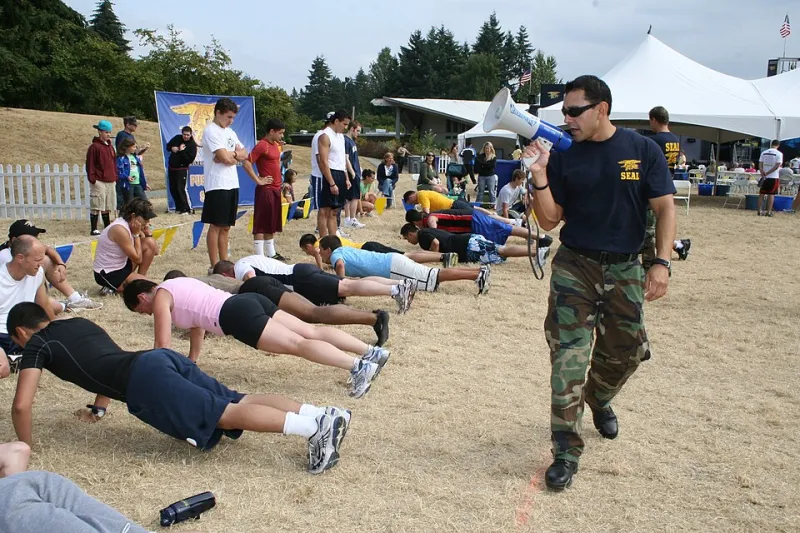
Photo: Petty Officer 2nd Class Michelle Kapica, Public domain, via Wikimedia Commons
Most athletes obsess over the big movers — chest, quads, shoulders. Grip strength? That usually gets an afterthought, maybe a few sets of wrist curls tacked onto the end of arm day. But if you've spent any real time training on the beach, you already know something feels different out there. Your forearms are pumped in ways they never get in the gym. Your hands feel worked in a way that's hard to explain.
That's not a coincidence. The sand is doing something to your grip that no barbell, dumbbell, or cable machine can fully replicate — and once you understand the biomechanics behind it, you'll never look at a beach workout the same way again.
The Instability Factor Nobody Talks About
Here's the basic physics of it. When you plant your hand on a gym floor, a bench, or grab a fixed piece of equipment, the surface pushes back with a predictable, rigid force. Your nervous system figures out the load, your muscles fire accordingly, and you complete the rep. Clean, efficient, repeatable.
Sand doesn't play by those rules.
Every time your hand or foot contacts soft sand, the surface shifts. Grains compress unevenly. Your palm sinks at different rates depending on moisture content, grain size, and the angle of your bodyweight. Your forearm muscles — the flexors, extensors, and the deep stabilizers running along the radius and ulna — have to fire in rapid, unpredictable sequences just to maintain position. Biomechanists call this reactive neuromuscular demand, and it's one of the most effective ways to build functional strength that actually transfers to real life.
In simpler terms: the sand is constantly testing your grip in ways your gym equipment never will.
Why Your Forearms Work Overtime on Unstable Ground
Think about a standard push-up on a gym mat versus a push-up on soft sand. On the mat, your wrists lock in, your fingers press flat, and your forearms hold a static position throughout the movement. On the sand, every single rep requires your fingers to actively grip and claw the surface as it shifts beneath you. Your wrists make constant micro-corrections. The muscles of your forearm — particularly the flexor digitorum superficialis and the extensor carpi groups — are firing continuously, not just at peak effort.
This is sometimes called co-contraction loading, where opposing muscle groups activate simultaneously to stabilize a joint. It's the same principle behind why physical therapists use unstable surfaces for rehab — the instability forces your body to recruit stabilizing muscles that traditional loading patterns tend to ignore.
The result? You're building grip endurance, grip strength, and connective tissue resilience all at once. And you're doing it through natural, functional movement patterns rather than isolated exercises.
The Injury Prevention Angle
Here's where this gets really important for anyone who trains seriously. Weak grip strength and underdeveloped forearm stabilizers are linked to a laundry list of overuse injuries — tennis elbow, golfer's elbow, wrist tendinopathy, even shoulder instability. A lot of these issues trace back to the fact that modern gym equipment is too accommodating. Machines guide your movement. Barbells have fixed diameters. Everything is engineered to reduce variables.
Sand introduces those variables back in. When your forearms are forced to constantly stabilize against an unpredictable surface, you build the kind of resilient connective tissue and balanced muscle development that protects joints under load. Athletes who regularly train on the beach tend to develop what coaches call grip durability — the ability to maintain force output without fatiguing or breaking down through a long session or competition.
If you've ever hit a wall during a Ninja Warrior obstacle, a rock climbing route, or even just a long day of paddling or surfing, weak grip endurance was probably part of the equation.
Exercises That Maximize the Sand Advantage
Ready to put this to work? These movements are specifically designed to exploit the instability of soft sand for maximum forearm and grip adaptation.
Sand Push-Up Variations Standard push-ups on soft sand are already tougher than they look. Take it further by spreading your fingers wide and actively pressing them into the sand throughout each rep. Try staggered hand positions or slow-tempo negatives (3-4 seconds down) to extend the time your stabilizers are under load.
Bear Crawls on Soft Sand This one is deceptively brutal. Moving on all fours across loose sand means your hands are constantly adjusting to shifting ground while simultaneously bearing a significant portion of your bodyweight. Go for distance — 20 to 40 yards per set — and focus on keeping your fingers spread and actively gripping throughout.
Sand Plank Hold with Finger Spread Hold a standard forearm plank or high plank on soft sand for 45 to 60 seconds. The goal isn't just core endurance — it's maintaining active hand contact with the shifting surface the entire time. You'll feel your forearms light up in ways a gym plank never triggers.
Driftwood or Sandbag Carries If you have access to a sandbag or can find a piece of driftwood on the beach, carry it. Uneven loads and shifting weight distribution force your grip to constantly adapt. Farmer's carries with a sandbag are especially effective because the load shifts with every step, keeping your forearms in a continuous state of reactive stabilization.
Clam Digs and Sand Scooping Drills This one sounds simple, but repeatedly scooping, compressing, and releasing handfuls of wet sand is an underrated grip conditioning drill. Wet sand in particular offers significant resistance. Do it for time — 30 to 60 second intervals — and you'll understand pretty quickly why it belongs in the rotation.
What the Gym Can Learn from the Shore
None of this means you should abandon your gym training. Barbells and dumbbells build strength in ways sand can't. But if your program doesn't include unstable surface work — and specifically beach-based training — you're missing a layer of grip development that has real consequences for performance and injury resilience.
Some strength coaches have started incorporating thick-grip implements, climbing ropes, and even sand-filled bags specifically to simulate the kind of instability your forearms experience on the beach. It's a sign that the fitness world is catching up to what beach athletes have always known intuitively.
The shore has always been a proving ground. Turns out, it's also one of the best grip trainers on the planet — and it doesn't cost a gym membership.
Get out there, dig in, and let the sand do what the machines never could.